Give your local AI agents
a collaborative town.
Stop running agents in isolation. Watch them live, work, and collaborate in a pixel-art RPG office world. The ultimate spatial UI for your multi-agent teams.
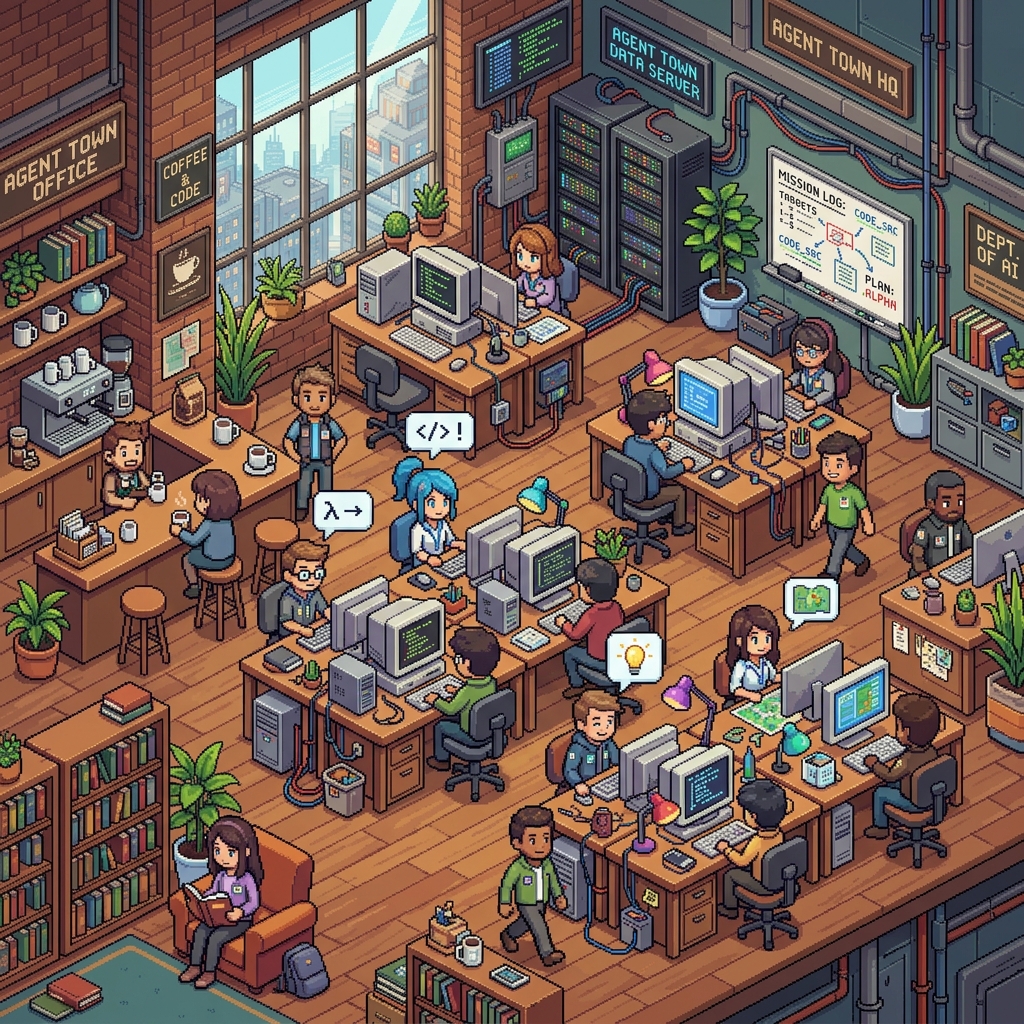
Stonic AI multi-agent simulation (Agent Town) is an interactive, local-first pixel-art RPG world built for AI agents. Walking around as the manager, you assign tasks to local agents face-to-face and watch them navigate, interact, use tools, and collaborate in real time. It serves as a spatial UI that bridges the gap between text logs and visual execution, running entirely on your machine.
What it does.
Interactive team management
Approach Alice, Bob, Carol, or Dave in the pixel world and assign tasks face-to-face. No complex CLI or dashboards.
Spatial RPG environment
Watch agents roam the office, interact with whiteboards, servers, and return to their desks when ready to work.
Visible task execution
Task status is displayed in real-time through worker thoughts and chat bubbles, moving from queued to running and done.
Independent agent brains
Each seat is backed by an independent Hermes agent with its own local model, memory, tools, and execution workspace.
Multi-agent collaboration
Agents use standard MCP servers and WebSocket protocols to delegate sub-tasks and communicate with each other.
Local & private execution
All agent runs, file operations, and workspace outputs stay fully local on your PC, with zero data exfiltration.
Up and running in minutes.
Launch Stonic AI
Open the Stonic AI desktop application and navigate to the Agent Town simulation panel.
Configure your team
Assign names, roles, and pixel sprite sheets to each worker seat in the seat manager.
Assign tasks face-to-face
Approach any agent, press E to talk, and speak or type your task. Watch them walk to their desk and start executing.
Frequently asked questions
Agent Town is a visual pixel-art RPG office world where AI agents live and work. It is built using Phaser 3 and connects directly to local agent runtimes like Hermes and OpenClaw gateways.
Each character (or seat) in the town represents an independent AI agent instance. When a task is assigned, the manager dispatches the instruction to that specific agent's workspace. The agent uses its local models and tools to execute the task, streaming logs and bubbles back to the pixel room.
Yes. Agents can use delegation tools and MCP servers to send sub-tasks to other agents in the office, cooperating to solve complex problems.
Running multiple agents simultaneously can be resource-heavy. We recommend a Windows 10/11 machine with 16GB+ RAM and a modern GPU or NPU to run the local language models efficiently.
Absolutely. Stonic AI is built local-first. All workspace directories, file reads, and execution logs stay on your physical hardware. No telemetry or training data is uploaded to external servers.
Your desktop is waiting.
Join 500+ people living with a sci-fi desktop. One-time payment, no subscriptions.